






The Voice over IP (VoIP) market has evolved significantly in recent years, transforming how businesses and consumers communicate. At the heart of this evolution is WebRTC (Web Real-Time Communication), a game-changing technology that allows real-time audio, video, and data transmission directly within web browsers and mobile apps, without needing additional plugins.
In 2025, businesses in the VoIP ecosystem face growing customer expectations, increased competition, and the demand for seamless, secure, and scalable communication. In this landscape, deploying a custom WebRTC softphone is not a luxury. It is a strategic necessity.
This blog explores why a custom WebRTC softphone is essential for VoIP businesses in 2025, diving into its benefits, market trends, development considerations, and how it gives your business a competitive edge.
What is a WebRTC Softphone?
A WebRTC softphone is a software-based phone that uses WebRTC to enable voice and video calls over the internet. It is usually embedded in a web browser, desktop application, or mobile app.
Unlike traditional softphones that require SIP clients and third-party plugins, WebRTC softphones are:
- Plugin-free
- Real-time
- Secure (thanks to DTLS/SRTP)
- Highly integrable
With WebRTC, VoIP businesses can offer browser-based or native app communications that rival legacy desk phones and conventional apps in both reliability and performance.
Market Trends in 2025: Why WebRTC is Surging
1. Remote and Hybrid Work Is the Norm
By 2025, over 70% of global organizations operate with hybrid or remote teams. WebRTC-based softphones empower teams to make and receive secure calls from anywhere without the need for dedicated devices or complex configurations.
2. Web-First Business Tools
Web-first is no longer optional. CRM systems, helpdesk platforms, and business tools are increasingly cloud-native and browser-centric. Embedding a WebRTC softphone into such systems ensures seamless workflows.
3. Security Demands are Higher Than Ever
With rising cybersecurity threats, businesses are turning to end-to-end encrypted communication. WebRTC supports secure media transport protocols (DTLS, SRTP), making it a safe choice for enterprise-grade communication.
4. Customer Experience is King
Consumers expect instant, frictionless communication. A WebRTC softphone embedded in a website or app enables instant calling, screen sharing, and chat without downloads or additional steps.
Benefits of a Custom WebRTC Softphone for Your VoIP Business

1. Tailored to Your Brand and Workflow
A custom softphone allows your business to:
- Use branded UI/UX
- Integrate specific features like call recording, CRM pop-ups, or call queuing
- Match your operational and support workflows
Off-the-shelf softphones can’t adapt to your unique processes the way a custom-built solution can.
2. Faster Onboarding and User Adoption
A softphone that’s intuitive, fast, and seamlessly integrated helps onboard new users faster. No additional downloads, auto-registration, and one-click calling result in better user experience.
3. Enhanced Security and Compliance
You can implement security controls tailored to your industry, including GDPR, HIPAA, or enterprise-specific compliance measures, in your custom softphone.
This is particularly crucial for:
- Healthcare providers (telemedicine)
- Financial services
- Government agencies
4. Omnichannel Capabilities
Combine voice, video, messaging, screen sharing, and even file transfer in one interface. This simplifies communication for both agents and customers.
5. Scalability for Global Operations
Need to support thousands of users or launch in multiple geographies? With a custom WebRTC softphone, you can scale backend infrastructure and user interfaces to meet demand.
Core Features of a Custom WebRTC Softphone in 2025
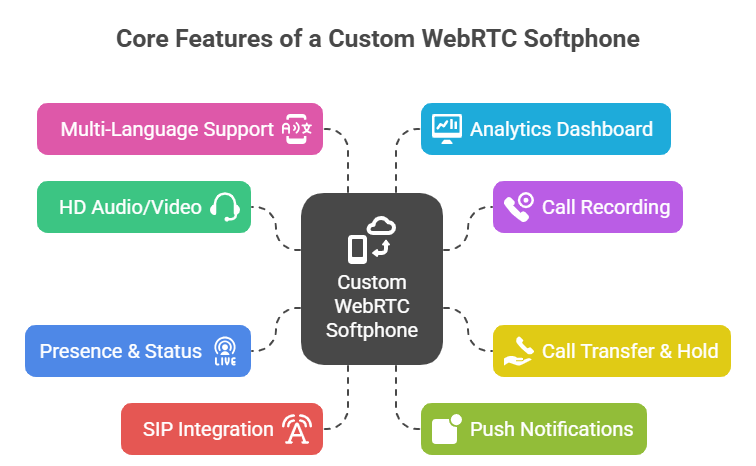
Your custom softphone can include:
| Feature | Description |
| HD Audio/Video | Clear communications powered by Opus and VP8 codecs |
| Call Recording | Store recordings securely for training or compliance |
| Call Transfer & Hold | Standard PBX features made available in browser or app |
| Presence & Status | See who’s online, busy, or available to chat or call |
| SIP Integration | Use SIP-over-WebSockets to connect with VoIP platforms |
| Push Notifications | Essential for mobile apps on Android and iOS |
| Multi-Language Support | Localize for global markets |
| Analytics Dashboard | Call reports, connection metrics, and KPIs |
Use Cases: Who Should Use Custom WebRTC Softphones?
1. VoIP Service Providers
Offer browser-based or app-based calling without hardware investment. Give customers a sleek, modern experience.
2. Call Centers & BPOs
Deploy softphones on agent desktops or within CRM tools to reduce training time and hardware cost.
3. Healthcare (Telemedicine)
Enable secure doctor-patient video calls directly in mobile or web apps.
4. SaaS and Customer Support Platforms
Embed calling and video chat within your dashboard to offer value-added services.
5. Education & Online Learning
Provide real-time classroom interaction between teachers and students.
Why Not Use a Generic Softphone?
Generic softphones
(like Zoiper or Bria) are versatile, but they come with limitations:
| Generic Softphone | Custom WebRTC Softphone |
| Requires manual setup | Auto-registration and provisioning |
| Generic UI | Fully branded experience |
| Plugin/install needed | Browser or app-based |
| Limited integrations | Deep CRM and backend integration |
| One-size-fits-all | Tailored features per business need |
For VoIP businesses in 2025, differentiation is key. A custom softphone gives you a competitive edge.
Technical Architecture: How a WebRTC Softphone Works
A typical WebRTC softphone architecture includes:
- Frontend (Web/Mobile App)
Built using JavaScript frameworks like React or Angular and uses WebRTC APIs for media capture and transport. - Signaling Server
Handles call signaling using SIP over WebSocket (WSS) and communicates with media servers and PBX systems. - STUN/TURN Servers
Ensures connectivity behind NAT and firewalls. - Media Server (Optional)
For group calls, recording, and media mixing using Janus or Kurento. - Backend/API
For user authentication, provisioning, call logs, billing, and more.
Key Technologies Involved
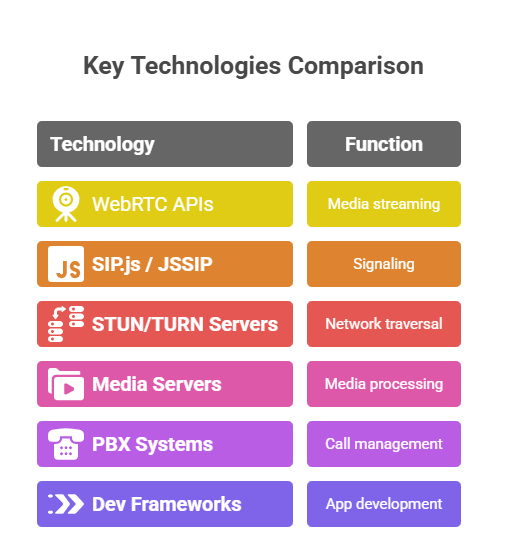
- WebRTC APIs (getUserMedia, RTCPeerConnection, RTCDataChannel)
- SIP.js / JSSIP for signaling
- STUN/TURN servers such as Coturn
- Media Servers like Janus, Kurento, or Mediasoup
- PBX Systems such as Asterisk or FreeSWITCH
- Dev Frameworks including React, Vue, Flutter, Kotlin, Swift
Custom WebRTC Softphone vs Traditional SIP Softphones
| Parameter | WebRTC Softphone | Traditional SIP Softphone |
| Installation | Browser-based or app | Needs software download |
| Security | Built-in encryption | Varies |
| Integration | Easy with APIs | Requires additional bridges |
| Cross-platform | Yes | Limited or OS-dependent |
| UI Customization | Fully customizable | Limited |
| Call quality | Excellent with Opus | Depends on codec and settings |
| Deployment time | Fast if prebuilt | Longer setup required |
Challenges You May Face and How to Solve Them
1. Browser Compatibility
While WebRTC is supported by major browsers, some older versions or mobile platforms may behave differently. Use fallback mechanisms and test thoroughly.
2. Network Constraints
Firewall, NAT, and proxy issues can affect connectivity. Deploy reliable STUN and TURN servers.
3. Call Quality Issues
Packet loss, jitter, or latency can reduce quality. Implement adaptive bitrate and QoS monitoring.
4. Security Concerns
Unsecured endpoints can be vulnerable. Use TLS/WSS for signaling and DTLS/SRTP for media encryption.
Why Build One in 2025
- Web-first and mobile-first usage is increasing
- Customers expect in-app real-time communication
- Competitors are embedding communications into workflows
- Open-source tools make development faster and cost-effective
Cost of Building a Custom WebRTC Softphone in 2025
| Feature Set | Estimated Cost Range |
| Basic (Audio only) | $8,000 to $15,000 |
| Intermediate (Audio + Video + Recording) | $15,000 to $30,000 |
| Advanced (CRM integration, analytics, push notifications) | $30,000 to $70,000+ |
Final costs depend on feature depth, platforms, and location of the development team.
Choosing the Right Development Partner When hiring a WebRTC development company, look for:
- Proven expertise in WebRTC, SIP, and VoIP
- Experience building softphones or real-time apps
- End-to-end development capabilities, including backend and infrastructure
- Ongoing support and version updates
Final Thoughts: The Future is WebRTC-Enabled
The next wave of VoIP innovation hinges on flexibility, security, and seamless user experience. A custom WebRTC softphone empowers you to meet user expectations, differentiate your service, and control the entire communication experience from branding to analytics.
In 2025, standing out in the VoIP space means delivering not just voice services but fully integrated communication experiences. A custom softphone is your path forward.
Ready to Transform Your VoIP Business with a Custom WebRTC Softphone?
In 2025, delivering exceptional communication experiences is not optional — it’s the foundation of a successful VoIP business. Whether you’re a service provider, call center, SaaS platform, or enterprise IT team, building a custom WebRTC softphone is your opportunity to:
✅ Enhance user experience with seamless browser or mobile-based calling
✅ Strengthen your brand with a fully white-labeled communication interface
✅ Scale securely across regions, teams, and devices
✅ Replace outdated software with secure, plugin-free, real-time communication
✅ Integrate deeply with your CRM, ticketing, or internal systems for operational efficiency
At Sheerbit, we specialize in developing end-to-end, fully customizable WebRTC softphone solutions that are reliable, scalable, and built for your specific use case. From UI/UX design to SIP integration, STUN/TURN configuration, and analytics dashboards — we cover it all.
We’ve helped VoIP providers, telecom startups, healthcare firms, education platforms, and enterprise SaaS companies launch production-ready softphones that support thousands of users and millions of secure calls.
👉 Stop settling for one-size-fits-all softphones. Empower your business with a solution that’s designed around your users and goals.
FAQs
What is a WebRTC softphone?
A browser- or app-based phone that enables voice and video calls over the internet using WebRTC.
Is WebRTC secure?
Yes, it uses DTLS and SRTP for encrypted media and signaling.
How long does it take to build a custom softphone?
Typically 4 to 12 weeks, depending on features.
Can it be integrated with CRM systems?
Yes, custom softphones can be integrated deeply with CRMs.
Will it work on mobile devices?
Yes. WebRTC supports mobile browsers and native apps.
What is the cost of development?
Costs range from $8,000 to $70,000+, depending on requirements.
Do I need SIP support?
Yes, SIP over WebSockets is commonly used for signaling in VoIP systems.
Can it have my company’s branding?
Absolutely. Customization includes logo, colors, and user interface.
Is WebRTC better than SIP?
WebRTC and SIP work together. WebRTC handles media; SIP handles signaling.
Why not use a ready-made softphone?
Generic tools lack deep integration, flexibility, and branding control.

