Future of Cloud PBX: SIP Ingress in WebRTC and AI-Driven Telecom
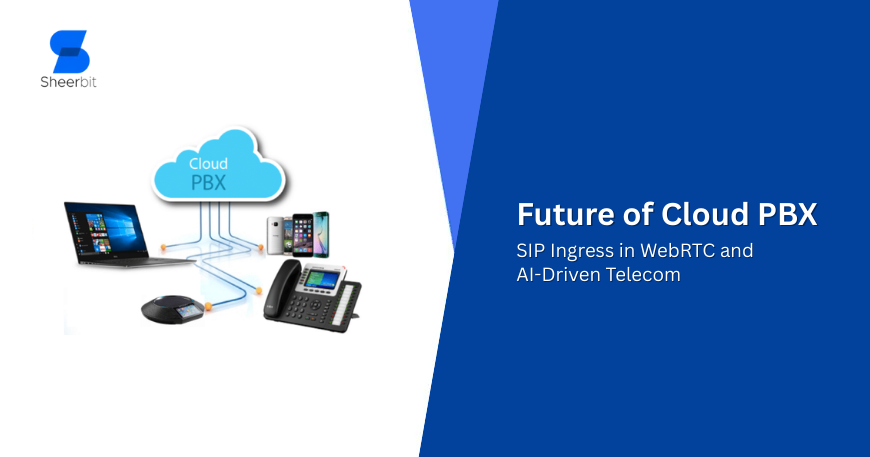
Cloud PBX systems are undergoing a revolutionary transformation, driven by the seamless integration of SIP ingress for legacy telephony bridging, WebRTC for native browser-based communication, and AI for intelligent automation and insights. This triad positions cloud PBX as the intelligent backbone of next-generation telecom, shifting from static call routing to dynamic, data-driven platforms that enhance customer experiences and operational efficiency. Introduction The evolution of cloud PBX represents a pivotal shift in telecommunications, where traditional voice infrastructure meets cutting-edge web and AI technologies to create programmable communication ecosystems. SIP ingress serves as the robust entry point, securely terminating carrier SIP trunks and PSTN connections while applying real-time policy controls, fraud detection, and media transcoding to prepare streams for modern consumption. WebRTC complements this by enabling plugin-free voice, video, and data channels directly in browsers, CRMs, and SaaS applications, supporting scalable multi-party sessions via SFUs and adaptive streaming for low-latency global delivery. AI elevates the entire stack, acting as an autonomous brain for predictive routing, real-time transcription across 100+ languages, sentiment analysis, and network self-optimization, turning every interaction into structured data for CRM enrichment and business intelligence. For VoIP providers and enterprises building on platforms like FreeSWITCH or Asterisk, this convergence unlocks high-value use cases such as embedded calling in telemedicine or EdTech, AI-assisted contact centers with 15-20% conversion lifts, and frictionless global collaboration with instant translation. As the cloud comms market surges toward $50B+ by 2030 at 25% CAGR, early adopters of SIP-WebRTC-AI architectures gain a decisive edge over legacy systems. SIP Ingress: The Connectivity Anchor SIP ingress forms the foundational layer in cloud PBX, acting as a programmable gateway that interconnects with PSTN carriers, enterprise trunks, and multi-tenant environments through deep packet inspection and dynamic routing. It handles codec transcoding (G.711 to Opus/AV1), DDoS mitigation via WAFs, and per-tenant policies for rate limiting, geography-based failover, and toll fraud prevention, ensuring carrier-grade uptime above 99.99%. Advanced deployments integrate SIP ingress with edge proxies like Kamailio, feeding processed media into Kubernetes-orchestrated pipelines for seamless handoff to WebRTC gateways, while exposing APIs for custom logic in fraud scoring or QoS prioritization. This layer decouples legacy voice from modern apps, allowing providers to monetize existing SIP investments through cloud-native extensibility. WebRTC: Frictionless Experience Layer WebRTC transforms cloud PBX into an embeddable communication fabric, delivering peer-to-peer media with DTLS-SRTP encryption, Data Channels for co-browsing, and ML-driven congestion control for consistent quality over variable networks. Selective Forwarding Units (SFUs) like Janus or Mediasoup enable scalable video rooms, click-to-call in Salesforce/HubSpot, and in-app softphones without desk hardware or plugins. Security features such as JWT identity assertion and TURN/STUN traversal ensure HIPAA/GDPR compliance, while adaptive bitrate adjusts streams in real-time, making WebRTC ideal for hybrid workforces shifting fluidly between voice, video, chat, and screen share in browser-based workspaces. This positions cloud PBX as a native web primitive, powering vertical SaaS like logistics dispatching or virtual classrooms with sub-150ms session setup. AI: The Autonomous Intelligence Core AI redefines cloud PBX operations, deploying agentic models for traffic engineering, anomaly detection in CDRs/QoS metrics, and automated scaling that slashes MTTR from hours to minutes. Application-side AI delivers real-time STT/NLP via Whisper/Deepgram for transcription, intent detection, emotion scoring, and PCI compliance flagging, with predictive analytics routing calls to optimal agents for 15-20% outcome improvements. In multi-tenant setups, federated learning aggregates anonymized patterns across tenants for cross-optimization, while event streams like Kafka pipe insights to ClickHouse for BI querying, evolving the PBX from cost center to revenue engine. This AI-native approach anticipates issues, personalizes interactions, and generates structured data feeds for ERPs and analytics platforms. Converged Architecture and Use Cases Production architectures layer SIP proxies, WebRTC media servers, and AI services on Kubernetes with edge CDNs for low-latency global distribution, using Kafka for real-time data flows and serverless functions for STT/routing. Key use cases include AI contact centers blending SIP calls with WebRTC dashboards, live summaries, and auto-dispositioning; embedded comms in vertical SaaS for telemedicine compliance calls; and enterprise optimizations like best-time-to-call predictions. Challenges like SIP-WebRTC codec mismatches and data sovereignty are addressed through microservices isolation, regional AI hubs, and standards-compliant signaling, enabling seamless multi-channel experiences. Implementation Roadmap Phase 1: Aggregate SIP trunks and deploy basic WebRTC softphones with TURN infrastructure. Phase 2: Add AI transcription/IVR and predictive routing via APIs. Phase 3: Scale to autonomous ops and embed in partner SaaS, benchmarking with load tests for <150ms setups. Partner with CPaaS like Twilio for SIP onboarding while differentiating via proprietary AI models. Conclusion The SIP ingress, WebRTC, and AI convergence elevates cloud PBX from virtual telephony to an intelligent, API-first platform that embeds natively in digital ecosystems, driving automation, insights, and growth. Telecom providers and VoIP innovators must prioritize AI-native designs and WebRTC interoperability to capture the exploding demand for predictive communication services. By 2026 and beyond, platforms mastering this stack will deliver not just connectivity, but personalized, outcome-optimized experiences that turn every call into a strategic asset, powering the $50B cloud comms era with unmatched efficiency and innovation.
FusionPBX vs. FreePBX vs. 3CX IP PBX: Open Source PBX Comparison
As we navigate the mature VoIP landscape of 2026, Managed Service Providers (MSPs) and telecom entrepreneurs face a critical infrastructure decision that dictates their long-term profitability: selecting the right engine to power their hosted voice services. The market has consolidated around three distinct philosophies, represented by FusionPBX, FreePBX, and 3CX. For providers aiming to deploy a scalable Multi Tenant IP PBX Solution, the choice is no longer just about feature lists—it is about choosing between carrier-grade architectural isolation, open-source modular flexibility, or a polished commercial ecosystem. However, the “best” platform is not universal; it depends entirely on your business model and technical appetite. While FusionPBX offers true native multi-tenancy that maximizes hardware ROI for providers, FreePBX remains the customizable standard for single-tenant deployments, and 3CX delivers a streamlined, vendor-supported route for rapid resale. This guide dissects the technical realities, security architectures, and hidden costs of each platform, helping you decide whether to build a custom empire or leverage a proven commercial product to become a successful Multi Tenant IP PBX Solution provider. FusionPBX: The Carrier-Grade Contender FusionPBX has cemented its reputation as the go-to platform for service providers who need true scalability without the licensing shackles of commercial software. Built as a sophisticated GUI for FreeSWITCH, it differs fundamentally from its Asterisk-based cousins by offering a true carrier-grade architecture designed for high concurrency. Architecture & Core Engine At its heart lies FreeSWITCH, a softswitch designed to handle thousands of concurrent calls with stability that Asterisk historically struggled to match on single instances. FusionPBX version 5.3, widely adopted by 2026, introduces a modernized dashboard, improved widget support, and tighter security integrations. Unlike Asterisk, which processes calls as a back-to-back user agent (B2BUA), FreeSWITCH can handle media with greater efficiency, making it ideal for the heavy lifting required by ITSPs. True Multi-Tenancy This is FusionPBX’s ace in the hole. Unlike FreePBX, which requires virtualization to separate customers, FusionPBX is designed from the ground up as a native Multi Tenant IP PBX Solution. A single installation can host dozens or even hundreds of separate domains (tenants), each with its own extensions, IVRs, and routing logic, all while sharing the same underlying resources. For an MSP, this dramatically lowers hardware costs and simplifies maintenance. Customization & Flexibility FusionPBX is incredibly flexible but has a steeper learning curve. The permissions system is granular, allowing you to create highly specific user roles. However, it lacks the “app store” simplicity of FreePBX’s module admin. You often need to understand the underlying dial plan (LUA scripts and XML) to make deep customizations. Pros: Unlimited scalability (hardware dependent), True Multi-Tenancy, No Licensing Fees (BSD license), Carrier Features (LCR/Billing). Cons: Steep learning curve requiring FreeSWITCH knowledge, UI is functional but less polished than commercial rivals. FreePBX: The Customizable Standard FreePBX remains the world’s most widely deployed open-source PBX. Powered by Asterisk, it is the “Swiss Army Knife” of telephony. With the release of FreePBX 17 running on Debian 12 and supporting Asterisk 21, the platform has modernized its OS dependency, moving away from the legacy CentOS ecosystem. Architecture & Ecosystem FreePBX 17 brings significant performance improvements and PHP 8.2 support, ensuring security compliance through late 2026. Its modular architecture allows administrators to install only what they need. Need a hotel wake-up service? There’s a module for that. Need a complex call center queue? There’s a module for that. The Multi-Tenancy Limitation Crucially, FreePBX is NOT natively multi-tenant. It is designed as a Customer Premise Equipment (CPE) solution—one PBX for one company. To use FreePBX as a multi-tenant solution, you must rely on virtualization (creating a separate container or VM for every customer). While this offers perfect isolation, it increases hardware overhead and management complexity compared to FusionPBX. Commercial Modules While the core is free, Sangoma (the parent company) monetizes FreePBX via commercial modules. Advanced features like Endpoint Manager (for auto-provisioning phones), High Availability, and sophisticated Call Center reporting often require paid licenses. Pros: Massive community support, Feature-rich via modules, User-friendly GUI for single tenants, Broad device support. Cons: No native multi-tenancy (inefficient for hosting many small clients), Reload delays on large systems, Paywalls for “Pro” features. 3CX: The Commercial Powerhouse 3CX has aggressively cornered the market for SMBs and MSPs who want a “it just works” solution. Version 20 (and subsequent updates like v20 Update 7) marked a major shift, removing the legacy management console in favor of a unified web admin dashboard and introducing “Multi-Company” capabilities. Architecture & Philosophy 3CX is proprietary software. You don’t get access to the code. In exchange, you get a polished, secure, and rigorously tested product. It runs on Debian Linux or Windows and includes a best-in-class mobile app (iOS/Android) and web client that users love. Multi-Tenancy (The “Multi-Company” Approach) 3CX v20 introduced a “Multi-Company” mode that allows a single instance to group extensions into independent departments or companies. However, this is not “carrier-grade” multi-tenancy in the same vein as FusionPBX. It is designed more for an MSP managing a few mid-sized clients or a conglomerate with distinct branches. Licensing is based on “Simultaneous Calls” (SC) system-wide, meaning all tenants share the same capacity limit. Licensing Model 3CX’s pricing model is subscription-based (annual). While there is a free tier for small startups, serious deployments require Pro or Enterprise licenses. This creates a recurring revenue stream for 3CX partners but a recurring cost for the end-user. Pros: Setup takes minutes, Unbeatable video/chat integration, “Secure by Default” architecture, Reliable mobile apps. Cons: Recurring annual fees, Inflexible proprietary code, Hard limits on simultaneous calls. Deep Dive: The Provisioning “Nightmare” (and How to Solve It) In a multi-tenant environment, the ability to deploy phones without touching them (Zero Touch Provisioning) separates the amateurs from the true Service Providers. 3CX: The “PnP” Standard 3CX remains the gold standard for ease of provisioning, provided you stay within their “Supported Hardware” garden (Yealink, Fanvil, Snom). Method: It uses Multicast PnP (Plug and Play). When a phone boots on the same LAN as a 3CX SBC or server, it pops up