







Overview
The adoption of VoIP (Voice over Internet Protocol) has transformed how businesses communicate—moving from expensive legacy telephony systems to cloud-driven, scalable, and secure real-time communication infrastructure. In 2025, VoIP is not limited to voice; modern systems combine WebRTC-powered browser experiences, AI-driven routing, CPaaS features, SIP trunking, multi-tenant PBX capabilities, and deep CRM integrations.
Why read this?
This guide helps businesses, CTOs, product owners, and telecom founders understand the technical and commercial aspects of VoIP development: when to choose custom development over SaaS, what technologies and architectures matter, security and compliance considerations, real-world use cases, and a practical pricing & timeline estimate for 2025.
Key takeaways
- Custom VoIP provides complete ownership, branding, and compliance advantages compared to off-the-shelf SaaS.
- WebRTC is the standard for browser-based voice and video; Opus is the recommended codec.
- Security must include TLS/SRTP, SBCs, DDoS protections, and fraud detection.
- Architectures that scale use microservices, containerization and distributed routing across regions.
- Expect development costs and timelines to vary widely depending on multi-tenancy, carrier integrations, and regulatory needs.
Who this helps
This guide is designed for CTOs & technology leaders, telecom product owners, SaaS founders adding communications features, enterprises replacing legacy PBX, call centers, MSPs and developers evaluating VoIP vendors.
What Is VoIP Development?
VoIP development refers to building communication systems that transmit voice, video, and multimedia over the internet using SIP, RTP, WebRTC, VoIP APIs, and modern telecom infrastructure. VoIP development includes designing architecture, provisioning servers, building signaling and media engines, integrating carriers, and developing applications like softphones, PBX systems, conferencing platforms, and call automation tools.
Modern VoIP development goes beyond calling — it enables unified communications, messaging, AI analytics, programmable voice/video APIs, and cloud-based telecom for global scalability. Businesses use VoIP to replace expensive PBX hardware, provide remote collaboration, manage customer engagement, and build telecom products that integrate deeply with CRM, helpdesk, and automation workflows.
Common deliverables from a VoIP development company
| Category | Deliverables |
|---|---|
| Infrastructure | SIP servers, SBC, NAT traversal, load balancing |
| Applications | Softphones, WebRTC apps, iOS/Android VoIP apps |
| Business features | IVR, dialers, ACD, voicemail, advanced routing |
| Analytics | Dashboards, call recordings, logs, KPIs |
| Integrations | CRM, Billing, Helpdesk, SMS & WhatsApp |
| Security & Compliance | TLS/SRTP, STIR/SHAKEN, HIPAA/GDPR readiness |
Why Businesses Choose Custom VoIP over Off-the-Shelf SaaS
Off-the-shelf telephony (RingCentral, Zoom Phone, etc.) offers fast setup but limited control. Custom VoIP gives you full ownership, deep workflow integration, and the flexibility to optimize costs and features long-term. For regulated industries, custom systems enable precise compliance controls and private data handling.
Core Technologies — What Your Vendor Must Know
A credible VoIP vendor must be proficient across protocols, telecom platforms, web/mobile stacks and cloud infrastructure:
Telecom & Protocols
SIP, RTP, SRTP, SDP, STUN/TURN/ICE, SIP-TLS, codecs such as Opus/G.711/G.729.
Platforms
Asterisk, FreeSWITCH, OpenSIPS, Kamailio, Janus (for WebRTC media).
Programming & Stack
WebRTC (JS), Node.js / Go / Python, React/Angular/Vue, Flutter/React Native for mobile, Redis/Kafka/Postgres for data and queues.
Cloud & DevOps
AWS/GCP/Azure, Docker/Kubernetes, CI/CD, observability stacks (Prometheus, Grafana, ELK) and auto-scaling patterns.
VoIP System Architecture — Patterns That Scale
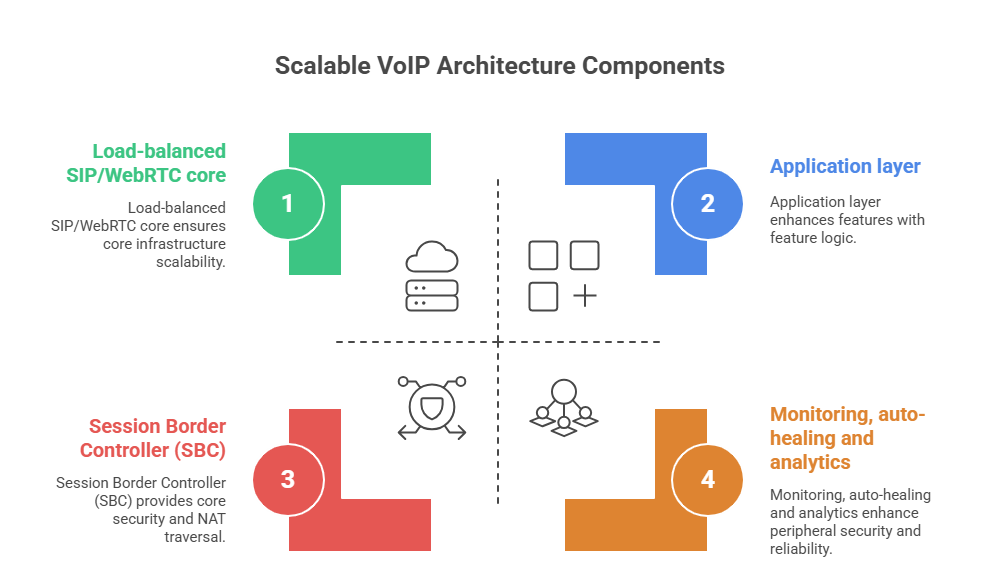
A scalable architecture typically includes:
- Load-balanced SIP/WebRTC core
- Session Border Controller (SBC) for security & NAT traversal
- Media servers for conferences & recording
- Application layer for feature logic
- Database + cache + message queue
- Monitoring, auto-healing and analytics
High-scalability patterns
Microservices for independent scaling, multi-tenant designs for SaaS, distributed routing for geolocation optimization and containerized auto-scaling for handling spikes.
Design considerations
Key design decisions to make early:
- Target users (internal vs. public customers)
- Expected call volume and concurrency
- On-premise, cloud, or hybrid deployment
- Latency and QoS expectations by region
- Carrier partnerships and international routing
- Compliance (HIPAA, GDPR, PCI-DSS)
- SLA & redundancy requirements
Essential & Advanced Features
Essential
- HD voice & video
- SIP & WebRTC calling
- IVR, call queuing & routing
- Voicemail, call recording
- SIP trunking & basic analytics
Advanced
- AI auto-attendant and transcription
- Voice biometrics & fraud detection
- Real-time emotion analysis
- Predictive dialers & VDI support
- Deep CRM-driven call intelligence
Industry Use Cases & Real-World Examples
Modern VoIP systems are used across industries:
| Industry | Use Case |
|---|---|
| Healthcare | HIPAA-compatible telehealth & support hotlines |
| Banking | Secure customer authentication & compliance-ready contact centers |
| Logistics | Automated dispatch, IVR tracking |
| SaaS | In-app WebRTC voice/video collaboration |
| eCommerce | AI-driven customer support |
| Hospitality | Multi-branch unified communications |
| On-demand marketplaces | Masked calling between users |
| Education | Virtual classroom & webinar platforms |
Security & Compliance — What To Audit Before You Buy
Before selecting a vendor or product, audit for:
- TLS & SRTP encryption for signaling and media
- SBC deployment & NAT traversal strategy
- DDoS & SIP flood mitigation
- Call fraud detection & toll-bypass protection
- Role-based access control & secure API design
- GDPR/HIPAA/PCI evidence & data residency options
- STIR/SHAKEN support for call authentication (where relevant)
Development Lifecycle — From Discovery to Production
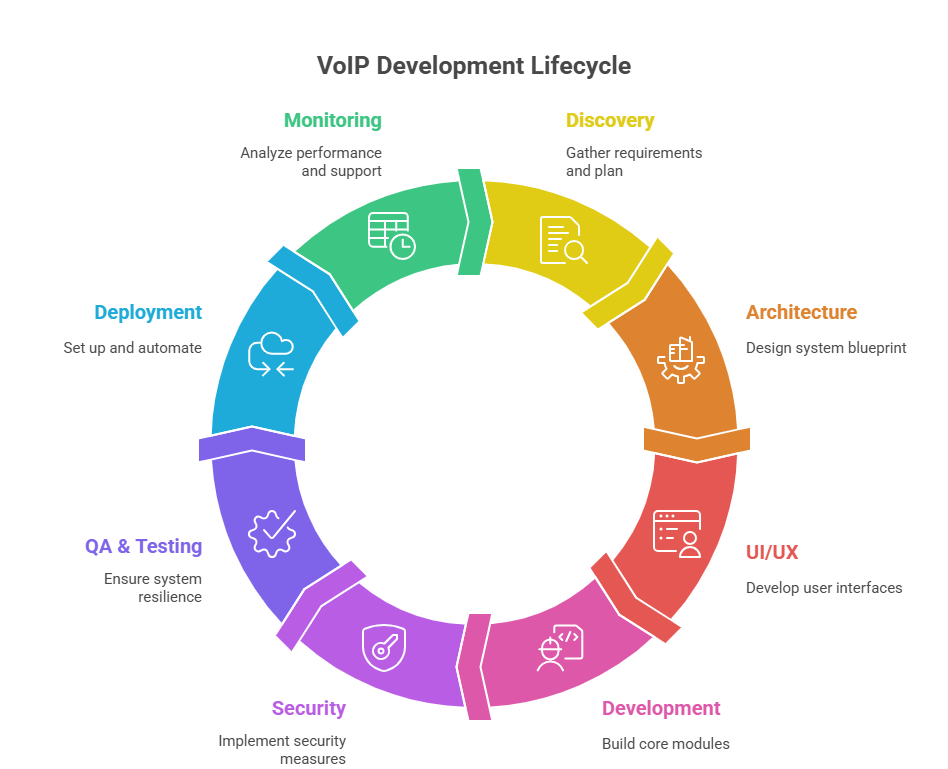
Typical stages and deliverables:
- Discovery: Requirements, compliance, integrations, deployment model
- Architecture: Blueprint, redundancy & scaling patterns
- UI/UX: Softphones, dashboards, agent consoles
- Development: Core telecom, API & app modules
- Security: Encryption, SBCs, IAM
- QA & Load Testing: Resilience & network variation testing
- Deployment: Cloud/on-prem setup, automation
- Monitoring: APM, call analytics, support & SLAs
Pricing Guide & Time Estimates (2025)
Indicative costs and delivery timelines (ballpark estimates):
| VoIP Solution Type | Price Range (USD) | Delivery Time |
|---|---|---|
| Softphone & WebRTC Calling App | $12,000 – $35,000 | 6–12 weeks |
| Multi-Tenant PBX Platform | $45,000 – $120,000 | 3–6 months |
| Full Telecom SaaS with Mobile Apps | $90,000 – $380,000 | 6–12 months |
| Custom CPaaS (Twilio-like) | $180,000 – $650,000+ | 9–18 months |
Maintenance & support is typically 15–25% of development cost per year depending on SLA.
How to Choose the Right VoIP Development Company — 10-Point Checklist
- Specialization in VoIP & telecom engineering (not just generic software).
- Proven experience with FreeSWITCH / Asterisk / OpenSIPS / Kamailio.
- Multi-tenant & high-concurrency deployments in their portfolio.
- Security & compliance certifications or demonstrable controls.
- WebRTC implementation experience for browser-native features.
- Load testing and chaos testing capabilities.
- Carrier & SIP trunk integration experience for global calling.
- Clear long-term support & monitoring offerings.
- Transparent pricing and predictable telecom billing.
- Solid case studies and client references.
Why Work With Sheerbit Technologies
Sheerbit is a specialized VoIP & WebRTC development company focused on building scalable telecom solutions for performance, security and growth. Our strengths include:
- 80+ VoIP projects delivered globally
- Expertise across Asterisk, FreeSWITCH, Kamailio, OpenSIPS & Janus
- Cloud deployments (AWS/GCP/Azure) and private SIP infrastructure
- Deep domain experience in healthcare, fintech, logistics & marketplaces
- 24/7 monitoring & managed support options
10 Frequently Asked Questions
Q1: Can I integrate VoIP into my CRM?
A: Yes — we integrate with Salesforce, HubSpot, Zoho, Freshworks and custom CRMs via secure APIs and webhooks.
Q2: Do you support telehealth compliance?
A: Yes — we build HIPAA-ready pathways, encrypted storage options, and audit logs required for medical communication.
Q3: Can my system handle 10,000+ concurrent calls?
A: Yes — using OpenSIPS or Kamailio as the signaling layer and FreeSWITCH/Asterisk or media servers for media path, we can architect systems for tens of thousands of concurrent sessions across regions.
Q4: Are mobile VoIP apps included?
A: We develop Android and iOS softphones using either SIP stacks or WebRTC-based approaches depending on requirements.
Q5: What codec gives best voice quality?
A: Opus provides excellent voice quality at variable bitrates and is preferred for WebRTC; G.711 remains common for PSTN interoperability.
Q6: Do you offer call masking?
A: Yes — masked calling (number anonymization) is standard for marketplaces and ride-hailing apps.
Q7: Who owns the source code?
A: Clients typically own the source code subject to the contract; we recommend clear IP terms in the SOW.
Q8: Can we migrate from Twilio to private VoIP?
A: Yes — migration paths and compatibility layers can be designed to reduce transition friction and cost.
Q9: Do you support white-label branding?
A: Yes — we provide UI/UX customization, branded domains and white-label deployment options.
Q10: Can you support ongoing maintenance?
A: Yes — we offer monthly, quarterly and dedicated support workforce plans with SLAs for uptime and incident response.
Next steps — quick checklist before you contact vendors
- Estimate current and 18-month expected concurrent call load
- Decide deployment preference: cloud / on-prem / hybrid
- List required compliance standards and geographical data residency needs
- Document required integrations (CRM, billing, SMS, analytics)
- Separate must-have vs nice-to-have features to keep scope predictable
- Identify the user personas that will use the system (agents, admins, customers)

