






Index
- Native Browser Support and Ease of Access
- Superior Call Quality: Audio and Video
- Enhanced Security Features
- Simplified Deployment and Maintenance
- Cross-Platform Compatibility and Mobility
- Cost Efficiency and Reduced Infrastructure
- Advanced Capabilities: Real-time Data, Screen Sharing, Integration
Introduction to Softphones and Communication Technologies
In today’s digitally connected world, businesses are increasingly adopting VoIP technologies to streamline their communications. Softphones—software-based phone applications—have revolutionized business telephony by enabling voice and video calls over the internet without dedicated hardware. Among softphones, two key technologies dominate: traditional SIP-based softphones and the emerging WebRTC softphones. Understanding the distinct advantages of WebRTC softphones over traditional SIP softphones is critical for organizations aiming to enhance communication efficiency, security, and user experience.
WebRTC Softphones: Definition and Core Technology
WebRTC (Web Real-Time Communication) is an open-source technology that allows real-time voice, video, and data sharing directly within web browsers or mobile apps without the need for extra plugins or software installations. It leverages peer-to-peer connectivity and native browser APIs to enable seamless communication experiences. WebRTC softphones operate in-browser or as lightweight apps, making them instantly accessible and highly flexible for modern business environments.
Traditional SIP Softphones: Overview and Architecture

Session Initiation Protocol (SIP) softphones are software applications that rely on the SIP communication protocol to establish voice and video sessions over IP networks. Unlike WebRTC, SIP softphones typically run as standalone applications that require installation, configuration, and operate through dedicated SIP servers. SIP is a mature and widely supported standard that provides robust session control, but it often involves more complex deployment and maintenance overhead compared to WebRTC.
Key Advantages of WebRTC Softphones Over SIP Softphones
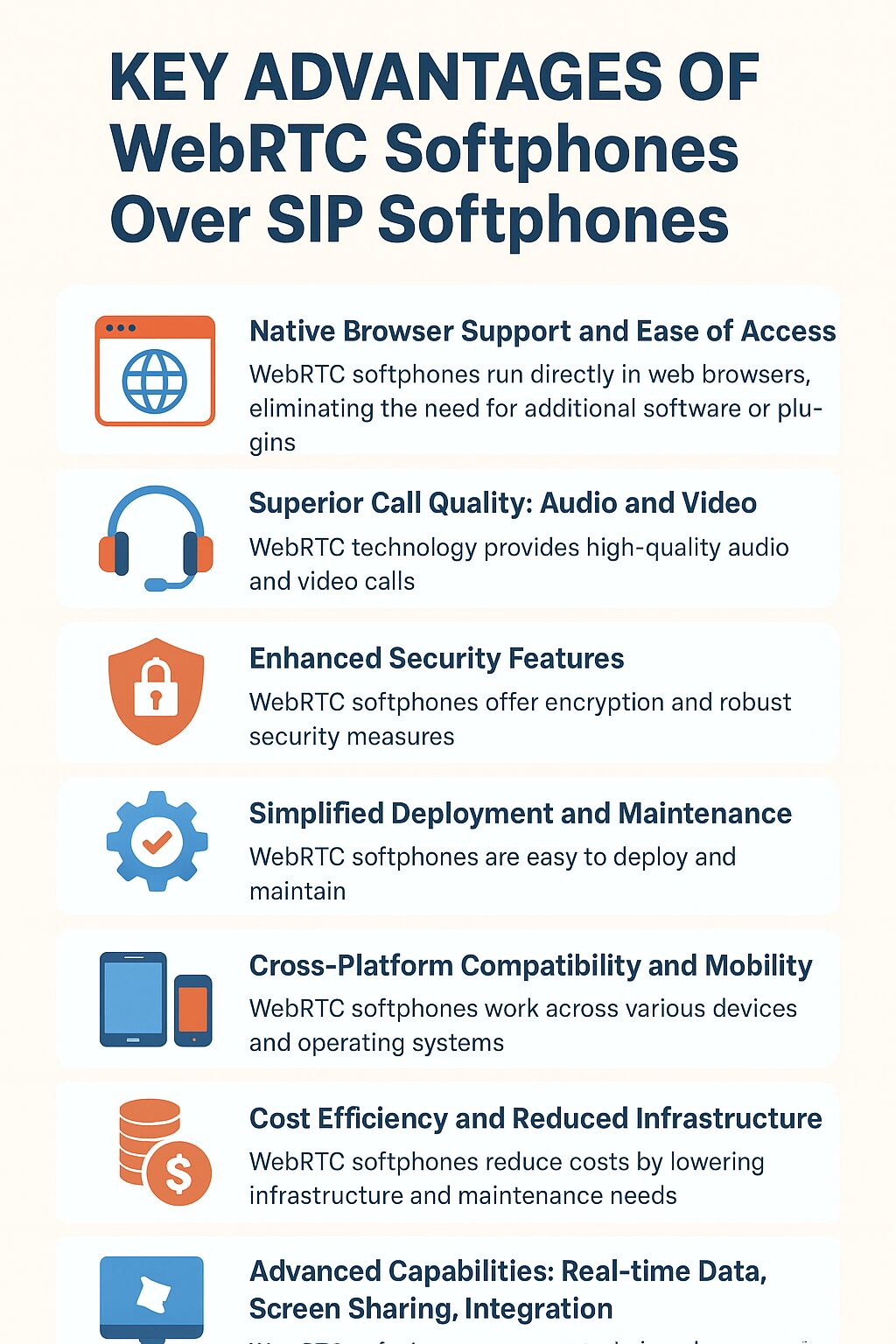
Native Browser Support and Ease of Access
WebRTC softphones are inherently browser-based, meaning users can access voice and video calling features directly through standard web browsers without downloads or plug-ins. This instant access drastically reduces setup time and eliminates compatibility issues related to operating system or device restrictions, enabling a smooth rollout for remote or hybrid workforces.
Superior Call Quality: Audio and Video
WebRTC incorporates advanced codecs such as Opus for audio and VP8/VP9 for video, which dynamically adapt to network conditions to provide crystal-clear communications. Peer-to-peer data transmission reduces latency and packet loss compared to traditional SIP setups, resulting in superior voice clarity and smooth video conferencing even over limited bandwidth connections.
Enhanced Security Features
Security is a built-in cornerstone of WebRTC architecture. It enforces end-to-end encryption of media streams using DTLS-SRTP protocols, securing calls and data exchanges from eavesdropping or interception. Unlike some SIP implementations where encryption may be optional or complex to configure, WebRTC’s encrypted communication is standard, giving businesses confidence in safeguarding sensitive conversations.
Simplified Deployment and Maintenance
Traditional SIP softphones often require manual software installation, separate client updates, and constant configuration tweaks to ensure interoperability with SIP servers and firewalls. WebRTC softphones, however, leverage browser-native functionality and protocols like ICE, STUN, and TURN to overcome NAT/firewall issues automatically, drastically cutting deployment time and reducing ongoing IT support needs.
Cross-Platform Compatibility and Mobility
WebRTC supports any modern device with a compatible browser, including desktops, laptops, tablets, and smartphones across operating systems—Windows, macOS, Linux, iOS, and Android. This universal compatibility means employees can stay connected from anywhere, whether in-office, at home, or on the go, using the device of their choice without sacrificing communication quality or features.
Cost Efficiency and Reduced Infrastructure
Implementing WebRTC softphones reduces capital expenditures on hardware phones and lowers costs associated with software licenses and maintenance contracts. Since WebRTC requires no proprietary software installation, businesses eliminate costs related to software deployment and upgrades. Additionally, WebRTC operates efficiently on existing internet infrastructure, enabling cost savings on network hardware and long-distance calling.
Advanced Capabilities: Real-time Data, Screen Sharing, Integration
Beyond voice and video calls, WebRTC softphones support rich communication features such as real-time text messaging, file transfer, screen sharing, and multi-device synchronization. Their open standards and JavaScript APIs enable seamless integration with CRM systems, helpdesk software, and business workflows, boosting productivity and enabling customized communication solutions tailored to organizational needs.
Use Cases and Adoption Scenarios Favoring WebRTC Softphones
WebRTC softphones excel in dynamic environments such as remote or hybrid workforces, customer support centers, and rapidly scaling startups. Their fast deployment, minimal user training, and robust feature sets make them the preferred choice for businesses requiring agility, secure communication, and unified collaboration tools accessible from anywhere.
Challenges and Considerations
Although WebRTC softphones offer multiple advantages, businesses must consider potential limitations such as dependency on browser compatibility, quality of internet connections, and the need for adequate backend infrastructure for scaling peer-to-peer connections in large enterprises. Proper vendor selection and solution customization are key to maximizing benefits.
Why Choose Sheerbit for WebRTC Softphone Solutions?
Sheerbit stands at the forefront of VoIP innovation, delivering cutting-edge WebRTC softphone solutions tailored to modern business needs. With Sheerbit, companies benefit from seamless browser-based communication, enhanced security protocols, and flexible integration capabilities that align with existing workflows. Our expert team ensures rapid deployment, ongoing support, and continuous innovation, empowering businesses to elevate their communication experiences while optimizing costs.
Conclusion and Call to Action
WebRTC softphones represent a transformative leap over traditional SIP softphones by combining superior call quality, enhanced security, simplified deployment, and rich communication features—all accessible directly through web browsers. For businesses seeking to modernize their communication infrastructure, adopting WebRTC softphones is a strategic imperative.
Discover how Sheerbit’s WebRTC softphone solutions can revolutionize your business communications today. Reach out to Sheerbit to learn more about seamless, secure, and scalable VoIP solutions customized for your enterprise success.

