






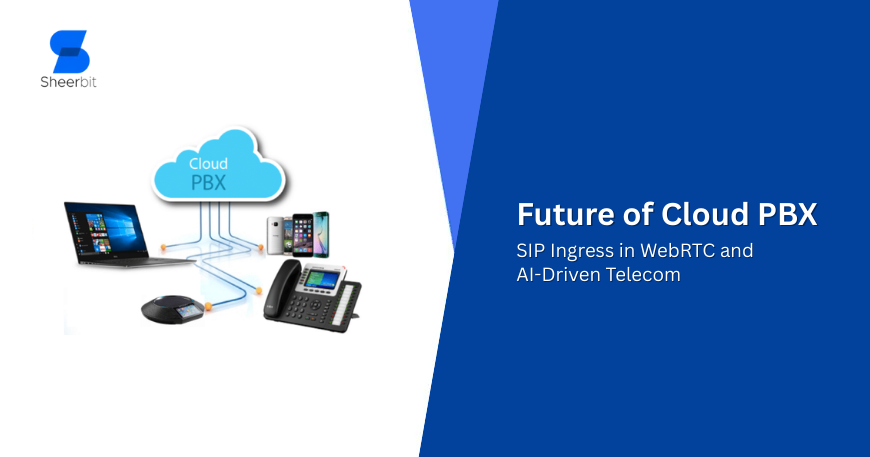
Cloud PBX systems are undergoing a revolutionary transformation, driven by the seamless integration of SIP ingress for legacy telephony bridging, WebRTC for native browser-based communication, and AI for intelligent automation and insights. This triad positions cloud PBX as the intelligent backbone of next-generation telecom, shifting from static call routing to dynamic, data-driven platforms that enhance customer experiences and operational efficiency.
Introduction
The evolution of cloud PBX represents a pivotal shift in telecommunications, where traditional voice infrastructure meets cutting-edge web and AI technologies to create programmable communication ecosystems. SIP ingress serves as the robust entry point, securely terminating carrier SIP trunks and PSTN connections while applying real-time policy controls, fraud detection, and media transcoding to prepare streams for modern consumption. WebRTC complements this by enabling plugin-free voice, video, and data channels directly in browsers, CRMs, and SaaS applications, supporting scalable multi-party sessions via SFUs and adaptive streaming for low-latency global delivery.
AI elevates the entire stack, acting as an autonomous brain for predictive routing, real-time transcription across 100+ languages, sentiment analysis, and network self-optimization, turning every interaction into structured data for CRM enrichment and business intelligence. For VoIP providers and enterprises building on platforms like FreeSWITCH or Asterisk, this convergence unlocks high-value use cases such as embedded calling in telemedicine or EdTech, AI-assisted contact centers with 15-20% conversion lifts, and frictionless global collaboration with instant translation. As the cloud comms market surges toward $50B+ by 2030 at 25% CAGR, early adopters of SIP-WebRTC-AI architectures gain a decisive edge over legacy systems.
SIP Ingress: The Connectivity Anchor
SIP ingress forms the foundational layer in cloud PBX, acting as a programmable gateway that interconnects with PSTN carriers, enterprise trunks, and multi-tenant environments through deep packet inspection and dynamic routing. It handles codec transcoding (G.711 to Opus/AV1), DDoS mitigation via WAFs, and per-tenant policies for rate limiting, geography-based failover, and toll fraud prevention, ensuring carrier-grade uptime above 99.99%.
Advanced deployments integrate SIP ingress with edge proxies like Kamailio, feeding processed media into Kubernetes-orchestrated pipelines for seamless handoff to WebRTC gateways, while exposing APIs for custom logic in fraud scoring or QoS prioritization. This layer decouples legacy voice from modern apps, allowing providers to monetize existing SIP investments through cloud-native extensibility.
WebRTC: Frictionless Experience Layer
WebRTC transforms cloud PBX into an embeddable communication fabric, delivering peer-to-peer media with DTLS-SRTP encryption, Data Channels for co-browsing, and ML-driven congestion control for consistent quality over variable networks. Selective Forwarding Units (SFUs) like Janus or Mediasoup enable scalable video rooms, click-to-call in Salesforce/HubSpot, and in-app softphones without desk hardware or plugins.
Security features such as JWT identity assertion and TURN/STUN traversal ensure HIPAA/GDPR compliance, while adaptive bitrate adjusts streams in real-time, making WebRTC ideal for hybrid workforces shifting fluidly between voice, video, chat, and screen share in browser-based workspaces. This positions cloud PBX as a native web primitive, powering vertical SaaS like logistics dispatching or virtual classrooms with sub-150ms session setup.
AI: The Autonomous Intelligence Core
AI redefines cloud PBX operations, deploying agentic models for traffic engineering, anomaly detection in CDRs/QoS metrics, and automated scaling that slashes MTTR from hours to minutes. Application-side AI delivers real-time STT/NLP via Whisper/Deepgram for transcription, intent detection, emotion scoring, and PCI compliance flagging, with predictive analytics routing calls to optimal agents for 15-20% outcome improvements.
In multi-tenant setups, federated learning aggregates anonymized patterns across tenants for cross-optimization, while event streams like Kafka pipe insights to ClickHouse for BI querying, evolving the PBX from cost center to revenue engine. This AI-native approach anticipates issues, personalizes interactions, and generates structured data feeds for ERPs and analytics platforms.
Converged Architecture and Use Cases
Production architectures layer SIP proxies, WebRTC media servers, and AI services on Kubernetes with edge CDNs for low-latency global distribution, using Kafka for real-time data flows and serverless functions for STT/routing. Key use cases include AI contact centers blending SIP calls with WebRTC dashboards, live summaries, and auto-dispositioning; embedded comms in vertical SaaS for telemedicine compliance calls; and enterprise optimizations like best-time-to-call predictions.
Challenges like SIP-WebRTC codec mismatches and data sovereignty are addressed through microservices isolation, regional AI hubs, and standards-compliant signaling, enabling seamless multi-channel experiences.
Implementation Roadmap
Phase 1: Aggregate SIP trunks and deploy basic WebRTC softphones with TURN infrastructure. Phase 2: Add AI transcription/IVR and predictive routing via APIs. Phase 3: Scale to autonomous ops and embed in partner SaaS, benchmarking with load tests for <150ms setups. Partner with CPaaS like Twilio for SIP onboarding while differentiating via proprietary AI models.
Conclusion
The SIP ingress, WebRTC, and AI convergence elevates cloud PBX from virtual telephony to an intelligent, API-first platform that embeds natively in digital ecosystems, driving automation, insights, and growth. Telecom providers and VoIP innovators must prioritize AI-native designs and WebRTC interoperability to capture the exploding demand for predictive communication services.
By 2026 and beyond, platforms mastering this stack will deliver not just connectivity, but personalized, outcome-optimized experiences that turn every call into a strategic asset, powering the $50B cloud comms era with unmatched efficiency and innovation.

